
PCB depaneling machine is the equipment used to separate individual printed circuit boards from a larger manufacturing panel after assembly. Although often treated as a final mechanical step, depaneling directly affects product reliability, yield stability, and long-term durability—especially in industrial, automotive, and high-density electronics.
In modern electronics manufacturing, depaneling is no longer just about separation. It is about controlling stress, maintaining dimensional accuracy, and protecting components that are increasingly fragile and densely packed.
⚙️ Why Depaneling Matters More Than Many Expect
In early PCB designs, boards were thick, components were sparse, and manual separation was common. Today’s PCBAs are thinner, multi-layered, and edge-populated.
Manufacturing teams often encounter:
- Cracked MLCCs near board edges
- Solder joint fatigue was discovered during aging tests
- Latent failures triggered by vibration or thermal cycling
In many investigations, the root cause traces back not to SMT or materials, but to how the panel was separated.
🧩 Main Types of PCB Depaneling Machines
Different depaneling methods exist to balance stress, speed, and cost:
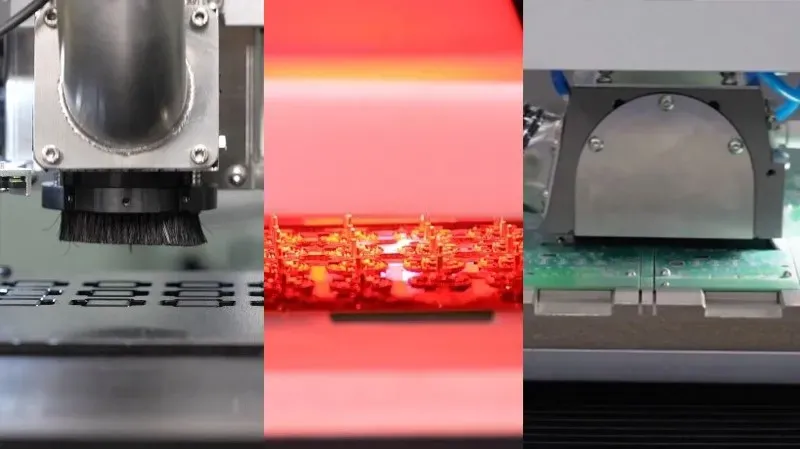
- Router depaneling machines use rotating cutters for complex outlines and dense layouts
- V-cut depaneling systems separate boards along pre-scored lines for high-volume production
- Laser depaneling machines remove material without mechanical contact, making them suitable for stress-sensitive designs
Each approach has strengths and limitations. Choosing the wrong one often leads to hidden reliability costs rather than immediate scrap.
🪚 Key User Pain Points in Real Production
Production engineers frequently raise similar concerns:
- “We pass AOI, but fail reliability testing.”
- “Edge components show unpredictable damage.”
- “Yield drops after ramp-up, not during pilot runs.”
These issues highlight a common misunderstanding: depaneling parameters that work at low volume may not remain stable during long production cycles.
🔧 Process Stability Over Cutting Speed
Field experience shows that industrial-quality depaneling prioritizes:
- Rigid machine frames and vibration control
- Consistent spindle or blade performance over time
- Reliable panel support and fixture design
A slightly slower, more controlled depaneling process often delivers better overall throughput by reducing rework and failure analysis.
📉 Cost Analysis: Equipment vs. Total Manufacturing Cost
When evaluating a PCB depaneling machine, the upfront price rarely tells the full story.
Hidden costs may include:
- Increased scrap during reliability testing
- Warranty returns caused by latent defects
- Engineering time spent on root-cause analysis
Many factories find that investing in durable, stable depaneling equipment lowers total cost per board—even if cycle time increases marginally.
🏭 Case Example: Industrial Control Electronics
An industrial automation manufacturer experienced intermittent field failures after six months of operation. Investigation linked the issue to micro-cracks formed during panel separation. After switching to a lower-stress depaneling setup with improved panel support, failure rates dropped significantly without any PCB redesign.
🛠️ Practical Takeaways for Engineers
From production-floor experience:
- Treat depaneling as a reliability process, not a finishing step
- Validate depaneling results through stress and vibration tests
- Match depaneling methods to board density and material behavior
- Prioritize long-term stability over short-term speed
These principles align depaneling decisions with industrial durability expectations.
⭐ Why Choose SEEZM-TEC?
SEEZM-TEC focuses on industrial-grade PCB depaneling solutions designed for durability, process stability, and long-term reliability. Our systems are developed with real production challenges in mind—supporting routing, V-cut, and advanced depaneling technologies for demanding applications.
If you would like to discuss depaneling strategies or evaluate suitable equipment for your production needs, please feel free to contact us.
WhatsApp: +8618929266433
E-mail: sales@seprays.com