
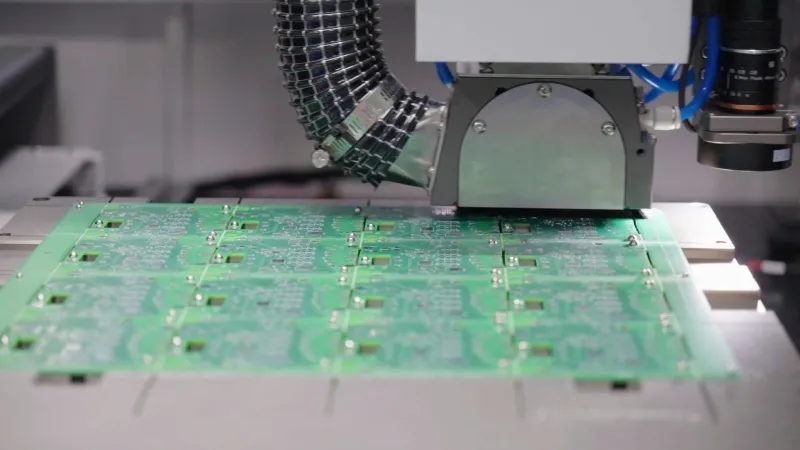
Router vs V-cut PCB depaneling stress is a long-standing discussion in SMT manufacturing, especially as PCBAs become thinner, denser, and more reliability-critical. Both methods are widely used, both are proven, and both can cause problems if applied in the wrong context.
So which one actually causes less stress? The practical answer is: router depaneling generally introduces lower mechanical stress, but V-cut remains efficient and acceptable within defined limits. This article shares experience-based insights from global EMS and OEM production lines, focusing on real stress behavior, cost trade-offs, and application boundaries rather than absolute claims.
🔍 Why Stress During Depaneling Matters More Than Ever
Mechanical stress introduced during depaneling does not always cause immediate failure. Instead, it often leads to:
- Micro-cracks in MLCCs and BGAs
- Latent solder joint fatigue
- Early failure after thermal cycling
- Intermittent field issues that are hard to trace
As product margins shrink and reliability expectations rise, depaneling stress has become a design-for-manufacturing topic—not just a process detail.
⚙️ How Stress Is Generated in V-Cut Depaneling
V-cut depaneling relies on controlled bending or shearing along pre-scored grooves. Stress characteristics include:
- Global bending stress across the entire PCB
- Peak stressis concentrated near the V-groove
- Stress transfer through copper layers and solder joints
When boards are thick, sparsely populated, or designed with sufficient edge clearance, this stress is usually acceptable. Problems arise as boards get thinner and components move closer to the edge.
🧭 How Router Depaneling Manages Stress Differently
Router depaneling removes material gradually using a rotating cutter. Compared with V-cut, it introduces:
- Localized cutting forces instead of global bending
- Lower peak stress at the component level
- More controllable force through speed and depth settings
From a stress perspective, routing spreads energy over time, which is why it is often preferred for dense or fragile PCBAs.
📊 Stress Comparison in Real Production
Field measurements and failure analysis reports show that:
- V-cut depaneling produces higher instantaneous stress peaks
- Router depaneling generates lower but longer-duration stress
- Sensitive components fail more often under bending than routing
In multiple EMS lines, boards that failed under V-cut separation passed reliability testing after switching to routing, without any design changes.
🧠 User Pain Point: Throughput vs Reliability
Many engineers face a familiar dilemma:
- V-cut is fast, simple, and low-cost
- Router depaneling is slower and requires fixtures
Choosing purely on speed can shift costs downstream into testing, rework, or warranty exposure—especially for automotive and industrial products.
💰 Cost Analysis: Short-Term Savings vs Long-Term Risk
From a cost perspective:
- V-cut advantages: lower machine cost, higher throughput
- Router advantages: reduced scrap, fewer latent defects
Several manufacturers found that even a small reduction in field failure rates justified the higher operating cost of routing for stress-sensitive products.
🏭 Case Insight: Industrial & Automotive Mixed Production
One mixed EMS facility initially used V-cut for all panels to maximize output. However, automotive control boards showed intermittent failures after thermal cycling. After migrating those SKUs to router depaneling—with optimized fixturing and low-stress parameters—the failures disappeared, while consumer products remained on V-cut lines.
This hybrid approach balanced cost and reliability without over-engineering.
🛠️ Practical Guidelines for Choosing Between Router and V-Cut
Experienced process teams typically apply these rules:
- Use V-cut for thicker boards with generous edge clearance
- Use router depaneling for thin, dense, or high-reliability PCBAs
- Validate stress through trials, not assumptions
- Treat depaneling as part of DFM, not post-process handling
Stress is manageable—but only when the method matches the product.
🌍 Alignment with Global Manufacturing Expectations
Global SMT lines are increasingly segmenting depaneling strategies by product risk level. Stress reduction is no longer optional for automotive, medical, and industrial electronics—it is part of audit and qualification discussions.
💬 Why Choose SEEZM-TEC?
SEEZM-TEC supports both router and V-cut PCB depaneling solutions, helping manufacturers select and fine-tune the right depaneling method based on stress sensitivity, production volume, and long-term reliability goals. With hands-on experience across mixed SMT production environments, SEEZM-TEC focuses on practical, stress-aware depaneling strategies rather than one-size-fits-all approaches.
If you would like to evaluate depaneling stress risks for your PCB design or compare routing and V-cut solutions for your application, please feel free to contact us.
WhatsApp: +8618929266433
E-mail: sales@seprays.com