
PCB depaneling solutions for automotive electronics manufacturing are no longer a secondary consideration. In 2026, they directly influence reliability, compliance, and long-term field performance.
Automotive PCBs are different.
They don’t tolerate “acceptable defects.”
🚗 Why Automotive Electronics Change the Rules
Unlike consumer electronics, automotive systems operate under strict conditions:
- Wide temperature ranges
- Continuous vibration
- Long product lifecycle (10+ years)
- Zero tolerance for failure
This affects depaneling decisions.
Even small mechanical stress during cutting can lead to:
- Micro-cracks
- Solder joint fatigue
- Latent failures in the field
These failures don’t appear immediately.
They appear months—or years—later.
🔍 Real Pain Points in Automotive PCB Depaneling
From Tier 1 and EMS manufacturers:
- “Boards pass inspection, but fail in reliability tests.”
- “Edge damage is affecting coating and sealing.”
- “Components are too close to the cutting path.”
- “We need traceability for every board.”
These are not isolated issues.
They are structural challenges.
⚙️ Key Requirements for Automotive Depaneling
1. Low-Stress Cutting
Critical for sensitive components.
- Avoid mechanical vibration
- Protect solder joints
- Maintain structural integrity
2. High Precision
Automotive PCBs often have tight layouts.
- Components near edges
- Complex board outlines
- Multi-layer designs
3. Process Stability
Consistency matters more than speed.
- Repeatable results across batches
- Minimal variation between shifts
- Stable long-term operation
4. Traceability and Data Integration
Required for automotive standards.
- MES integration
- Process data recording
- Quality tracking
⚡ Choosing the Right Depaneling Method
Different methods serve different scenarios.
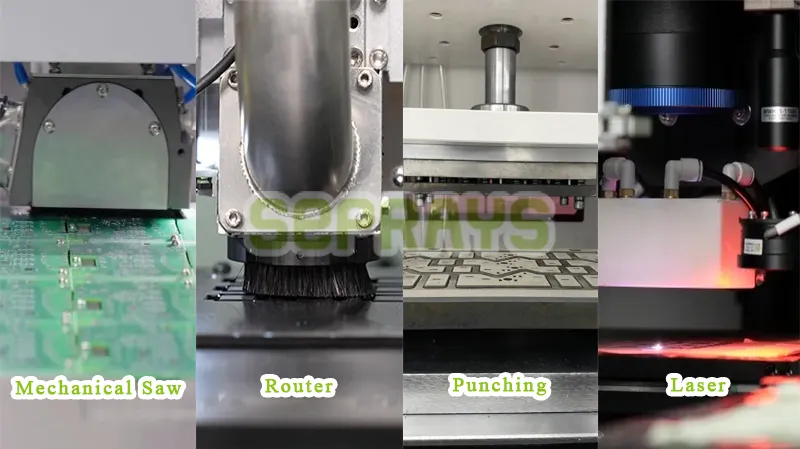
| Method | Stress Level | Precision | Suitability for Automotive |
|---|---|---|---|
| Router | Low-Medium | High | Widely used |
| Laser | Very Low | Very High | Ideal for sensitive PCBs |
| Saw Blade | Medium | Medium | Limited use |
| V-Groove | Low | Medium | Only for simple designs |
💡 A Counterintuitive Insight
Faster is not always better.
In automotive manufacturing:
- Slower, low-stress processes often improve yield
- Higher precision reduces long-term failure risk
Choosing the fastest method can increase total cost.
Because failures are expensive.
🧩 Case Scenario — Automotive Control Module Production
A manufacturer producing EV control boards faced:
- Micro-cracks near connectors
- Failed thermal cycling tests
- High rework rates
Initial setup:
- Router depaneling without optimization
After working with SEEZM-TEC, improvements included:
- Optimized routing parameters
- Introduced laser depaneling for sensitive areas
- Integrated inline system with MES
Results:
- Reduced mechanical stress
- Improved reliability test results
- More stable production output
The solution was not replacing everything.
It was combining the right methods.
💰 Cost Analysis — Short-Term vs Long-Term
Automotive manufacturing shifts cost priorities.
Short-term focus:
- Equipment price
- Cycle time
Long-term reality:
- Field failure cost
- Warranty claims
- Brand reputation
Key takeaway:
Reducing defects is often more valuable than increasing speed.
🔄 Hybrid Solutions — A Practical Approach
Many factories now adopt hybrid strategies:
- Router for general cutting
- Laser for sensitive areas
- Inline automation for consistency
This balances:
- Cost
- performance
- flexibility
There is no single “best” method.
Only the best combination.
🛠️ Implementation Tips from Real Projects
- Start with failure analysis (not equipment selection)
- Identify stress-sensitive areas on the PCB
- Test multiple depaneling methods
- Validate with reliability testing (thermal, vibration)
- Integrate with traceability systems early
Skipping these steps often leads to rework later.
🚀 Future Trends in Automotive Depaneling
Looking ahead:
- More use of lasers for EV and ADAS boards
- Higher demand for inline automation
- Stronger integration with Industry 4.0 systems
- Increased focus on process data and traceability
Depaneling is becoming a quality-critical process.
Not just a cutting step.
🚀 Why Choose SEEZM-TEC?
SEEZM-TEC Group focuses on delivering reliable and scalable depaneling solutions for demanding industries like automotive electronics.
SEEZM-TEC Group has been dedicated to PCB/FPC depaneling technology, providing a full range of solutions—milling-cutter depanelers, laser depanelers, V-groove depanelers, punching depanelers, and automated handling systems. Leading manufacturers, including Foxconn, Flextronics, State Grid, Luxshare, Compal, Wistron, China Electronics, Quanta, CRRC, China Aerospace, OPPO, ZTE, and Bosch, trust our equipment. It is used in factories across China and worldwide.
With proven experience in high-reliability applications, SEEZM-TEC supports customers with process optimization, hybrid solutions, and integration into automated production lines.
If you are looking for automotive PCB depaneling solutions, feel free to contact us.
WhatsApp: +8618929266433
E-mail: sales@seprays.com
❓ FAQ
1. Why is depaneling critical in automotive electronics?
Cutting stress can affect long-term reliability and cause hidden failures.
2. Which method is best for automotive PCBs?
Laser for sensitive areas, router for general use—often combined.
3. Can depaneling affect reliability tests?
Yes. Poor depaneling can lead to failure in thermal and vibration tests.
4. Is speed important in automotive depaneling?
Less than stability and quality. Reliability is the priority.
5. What is a hybrid depaneling solution?
A combination of different methods optimized for different PCB areas or requirements.