
PCB routing solution requirements in automotive electronics are becoming more demanding in 2026. A few years ago, many manufacturers mainly focused on cutting speed and cycle time. Today, the conversation is different. Automotive PCBA production lines are increasingly discussing reliability, traceability, process consistency, and long-term product stability.
This change is understandable.
An infotainment module restarting unexpectedly may create inconvenience. But a failure in a tire pressure monitoring system, battery management system, ADAS controller, or vehicle communication module can create much larger consequences.
That means even a process that looks small—PCB depaneling—can directly affect overall product quality.
Many production engineers have learned this after seeing seemingly acceptable boards later develop solder joint fatigue, edge cracks, or intermittent electrical failures.
The challenge is often not visible immediately.
Sometimes problems appear weeks later during environmental testing.
Sometimes they appear after vibration testing.
Sometimes they only appear after deployment.
🚗 Why Automotive PCBA Reliability Standards Continue to Rise
Automotive electronics have changed rapidly over the last several years.
Modern vehicles now integrate:
- ✓ Battery management systems (BMS)
- ✓ Tire pressure monitoring systems
- ✓ ADAS modules
- ✓ Vehicle communication systems
- ✓ Camera modules
- ✓ Radar systems
- ✓ Intelligent cockpit electronics
- ✓ Power control systems
Each system contains increasingly dense PCB designs.
Smaller layouts.
Higher component density.
Closer spacing.
More sensitive devices.
This creates new manufacturing pressure.
Traditional depaneling approaches that worked for consumer electronics do not always fit automotive requirements.
A process variation of only a few tenths of a millimeter can affect:
- Solder integrity
- Edge quality
- Component stress
- Long-term reliability
- Yield consistency
🔍 Common Problems Manufacturers Encounter During PCB Separation
From discussions across production environments, several recurring problems appear.
Problem 1: Stress damage near component edges
Components continue moving closer to board boundaries.
Large capacitors, connectors, ICs, and sensors may sit very close to routing paths.
Mechanical force becomes a concern.
Problem 2: Dust contamination
Routing creates debris.
Without effective collection systems, particles may remain around sensitive electronic areas.
This becomes critical in automotive modules.
Problem 3: Cycle time imbalance
Production managers sometimes increase spindle speed to improve throughput.
Unexpectedly, cutting quality may decline.
This creates a counterintuitive result:
Higher speed does not always mean higher output.
Rework can consume more production capacity than the time originally saved.
⚙️ Why Routing Accuracy Matters More Than Many Teams Expect
Many engineers initially focus on cutting speed.
But routing accuracy frequently becomes more important.
Automotive products often undergo:
- Temperature cycling
- Humidity testing
- Vibration testing
- Long-term operational verification
Small edge defects can later become failure points.
Typical risks include:
- ✓ Edge delamination
- ✓ Micro-cracks
- ✓ Burr formation
- ✓ Residual stress concentration
- ✓ Structural instability
Good routing performance reduces these risks before downstream processes begin.
📊 Routing Method Comparison for Automotive Applications
| Method | Stress Level | Edge Quality | Complex Shape Support | Initial Cost | Suitable Automotive Applications |
|---|---|---|---|---|---|
| V-Groove Separation | Medium-High | Moderate | Limited | Low | Simple PCB panels |
| Punching | High | Moderate | Limited | Medium | Standard products |
| Laser Depaneling | Very Low | Excellent | Excellent | High | Sensitive modules |
| Router Depaneling | Low | Excellent | Excellent | Medium | Automotive control boards |
For many automotive manufacturers, router-based solutions often create a practical balance between performance and cost.
🏭 Case Example: Automotive Sensor Production Upgrade
One automotive electronics manufacturer was producing vehicle sensor modules in high volume.
The original process used offline separation equipment.
Initial output appeared acceptable.
However, during reliability testing, they observed:
- Increased edge defects
- Variable cycle time
- Manual handling inconsistency
- Rework increase
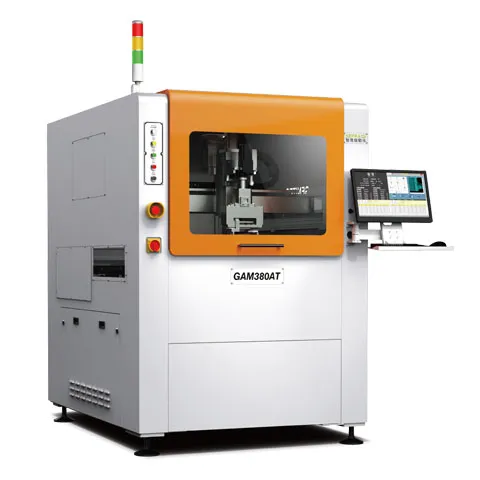
After evaluating production flow, they introduced an inline routing approach using the Seprays GAM380AT system.
The purpose was not simply faster cutting.
The goal was stable production.
Several observations appeared after implementation:
- ✓ Improved board handling consistency
- ✓ Better routing path repeatability
- ✓ Reduced operator dependency
- ✓ Improved workflow continuity
Interestingly, the largest improvement was not in speed.
It was process predictability.
That surprised the production team.
🧠 Experience Correction: Faster Is Not Always Better
One assumption frequently appears in manufacturing discussions:
“Higher spindle speed automatically means higher productivity.”
Reality is more complicated.
Excessive speed may introduce:
- Tool wear increases
- Additional vibration
- Edge quality variation
- Dust generation
The best result usually comes from balancing:
- Material characteristics
- PCB thickness
- Component spacing
- Routing path complexity
- Tool condition
Optimization often matters more than maximum settings.
🛠️ How GAM380AT Addresses Automotive Routing Challenges
The GAM380AT In-Line Gripper PCB Bottom Depaneling System is designed for automated routing environments requiring high consistency.
Several features align with automotive production requirements:
- ✓ High-speed spindle system
- ✓ CCD visual positioning
- ✓ Stable routing path control
- ✓ Inline automation integration
- ✓ Precision handling during transport
- ✓ Reduced manual intervention
For manufacturers processing complex automotive boards, these capabilities help maintain process consistency across production batches.
📈 Cost Perspective: Looking Beyond Equipment Pricing
Equipment cost discussions often focus on purchase price.
But automotive manufacturers increasingly evaluate:
- Yield stability
- Labor requirements
- Maintenance cost
- Rework rates
- Production continuity
- Long-term operational efficiency
An apparently inexpensive solution can become costly if reliability issues increase downstream failures.
The opposite can also happen.
Higher initial investment sometimes creates lower total operating costs over several years.
🔧 Practical Selection Questions Before Buying
Before selecting a routing solution, many engineers ask:
- How close are components to board edges?
- Are board shapes becoming more complex?
- Will future product designs change frequently?
- Does the line require automation compatibility?
- Is long-term reliability more important than initial machine cost?
The answers often determine the correct solution more effectively than specification sheets alone.
🎯 Final Thoughts
Automotive electronics continue moving toward higher density and greater reliability requirements in 2026.
Depaneling is no longer viewed as only a cutting step.
It has become part of the overall process quality control.
Reliable routing performance can influence downstream inspection, testing results, and product life expectancy.
For many manufacturers, success increasingly comes from optimizing the entire process rather than optimizing only one machine.
Why Choose Seprays Group?
For more than 30 years, Seprays Group has focused on advancing PCB and FPC depaneling technology while supporting manufacturers moving toward smarter and more reliable production environments.
Seprays Group has been dedicated to PCB/FPC depaneling technology, providing a full range of solutions—including milling-cutter depanelers, laser depanelers, V-groove depanelers, punching depanelers, and automated handling systems.
Our solutions are trusted by global manufacturers and leading companies, including Foxconn, Flextronics, State Grid, Luxshare, Compal, Wistron, China Electronics, Quanta, CRRC, China Aerospace, OPPO, ZTE, and Bosch, supporting production facilities across China and worldwide.
Why manufacturers work with Seprays:
- ✓ 30+ years of industry experience
- ✓ Complete depaneling technology portfolio
- ✓ Support for inline automation integration
- ✓ Customized solutions for automotive applications
- ✓ Proven deployment across global manufacturing environments
- ✓ Long-term technical support and service
If you are evaluating routing solutions for automotive PCBA production, please feel free to contact us.
WhatsApp: +8618929266433
E-mail: sales@seprays.com
FAQ
1. Why are automotive PCBAs more difficult to depanel than consumer electronics?
Automotive PCBAs often contain denser layouts, stricter reliability requirements, and more demanding environmental standards, such as vibration and thermal cycling tests.
2. Is router depaneling suitable for irregular automotive PCB shapes?
Yes. Router systems are commonly used for complex board geometries because they provide flexible cutting paths and high edge quality.
3. How does GAM380AT reduce manufacturing variation?
The system uses precision positioning and stable inline handling to improve process repeatability and reduce manual influence.
4. Can PCB routing damage components near board edges?
Improper routing parameters can create mechanical stress. Proper support, routing strategy, and optimized cutting settings help reduce risk.
5. Is inline routing better than offline separation for automotive production?
For high-volume environments, inline systems often improve workflow continuity, reduce manual handling, and provide better consistency across batches.